Saturday, March 24, 2007

About Jaipur


Welcome to JAIPUR


City palace


Located in the heart of the walled city, The City Palace Complex gives you an idea about the farsightedness of the founder of Jaipur Sawai Jai Singh. He left behind a legacy of some of the most imposing and magnificent architecture, art and craft structure in the city. Sawai Jai Singh built its many buildings but some of some of the structures were also built by later rulers and some of them are even dated in the in the twentieth century too. The palace is a blend of Mughal and Rajasthani architecture and the royal family still lives in a part of the palace.
On entering the complex and before the palace proper lies the Mubarak Mahal, the palace of welcome or reception. Sawai Madho Singh built the palace in the nineteenth century. It was used as a reception centre for the visiting personage. The building now forms the Maharaja Sawai Man Singh II Museum and on display here are a wide array of royal costumes, some very exquisite and precious Pashmina (Kashmiri) Shawls, Benaras silk saris, Sanganeri prints and folk embroidery. An unusual display is that of voluminous clothes worn by Maharaja Sawai Madho Singh I (ruled 1750-68).

The Maharani's Palace, the palace of the Queen paradoxically puts a display of the Rajput weaponry. The inestimable collections of weapons date back to even 15th century and are in a remarkable state of preservation. Remarkable amongst them is scissor-action dagger. This deadly weapon when thrust in bodies the handles were release to spread the blades. The dagger was then withdrawn tearing limb from limb of the body of the hapless victim into certain fatality. Other exhibits include protective chain armours, pistols, jewelled and ivory handled swords, a belt sword, small and assorted cannons, guns, poison tipped blades and gun powder pouches. The frescos on the ceiling are amazing and well preserved.


Jantar Mantar


One of the five observatories of India built by Sawai Jai Singh, the leading astronomer of his times and the founder of Jaipur, Jantar Mantar of Jaipur is one of the largest and the best preserved. The collection of giant masonry astronomical instruments continues to provide accurate information even today and is comparable with the most sophisticated instruments of today. The Brihat Samrat Yantra Sundia is said to be the most imposing of all instruments and is 27 m high. It helps in the calculation of local time as its shadow moves up to 4 m in an hour. It also helps in ascertaining the various attributes of the heavenly bodies and is definitely the highlight and center of attraction of the observatory. 'Jantar-Mantar' in Sanskrit means, 'Magical Device'. It was built between 1728 and 1734 based on the blueprints drafted by Maharaja Jai Singh.

Though Jaipur is based on Shilpa Shastra, the only deviation was that the holy area reserved by the Indian architectural treatise for the temple, was used by Jai Singh to make Jantar Mantar, his observatory, which showcases both the scientific and religious aspects of the genius king. The stone observation devices built here are of enormous dimensions and are unique for their precision, size and architectural perfection. Jai Singh founded Jai Praksh Yantra, which is set in the ground. A masterpiece in itself, it is one marble hemisphere about 4 m in diameter. It helps to ascertain the exact position of the sun on the coordinate lines, and hence the time. It lies in the centre of Jantar Mantar. There are 14 gnomes or shadow indicators in Jantar Mantar that are actually sundials and each have different functions attributed to them based on similar principles.

Albert hall


Located just outside the walled city is the sprawling Ram Niwas garden, which has always been a place for recreational activities since the reign of Sawai Ram Singh ji . This exquisitely designed garden with forcentry doors and a huge complex with small pools and fountains, flourishing lawns and beautiful flower beds all around was basically a famine relief project. It mostly attracted the British families where they entertained their guest and families quite often with the lavish gowns of the Men and formal colourful attires of the nobels and the high society club members, this park would come alive with the setting sun. Their individual 'BAGGIS' were parked outside in a line and the attendants served around as helpers. The children basically had a gala timely playing around in 'JHULAS'(swing) etc. During day time it was opened for the common public and by the evening it was opened for common public and by the evening it was available for exclusive lots.

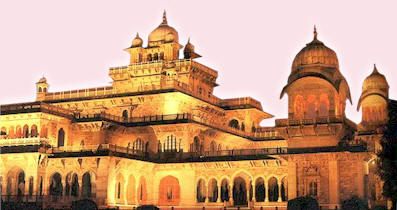
Situated in the middle of the garden as a centre attraction was the exquisitely built structure of Albert Hall, which was designed by sir Swinton Jacob, a British architect who designed many palaces in Rajasthan. Combining the elements of English and north Indian architecture known as the pride of the New Jaipur opened in 1887 AD, it is a very well maintained and impressive building displaying a rich collection of Art- de- fact like paintings, carpet, ivory, stone and metal sculptures and colourful crystal works etc. Just opposite the Albert Hall is one of the oldest ZOO in the country, harbouring different species of birds and animals. Another piece of attraction near the Albert Hall, is the Ravindra Rang Manch (theatre) with a modern art gallery and an performing art theatre both indoor and open air. Recently added joints of interest are streets dotted with food stalls which promises a delicious variety of Indian fast food certainly relished by the tourists.


Hawa Mahal


The best-known landmark and the signature monument of Jaipur, Hawa Mahal or Palace of Winds was built by the poet King Sawai Pratap Singh. Though, it is a part of the City Palace, it is situated on the other side of the road. It is the delicate façade that can be seen from outside of this palace, which is the most notable. The five-storeyed building flaunts Rajput architecture and artistry to its best including its 953 pink sandstone windows known as 'jharokhas' that are built in such as manner that it resembles a giant honeycomb. Meant for the ladies of the royal household, the building was built to allow them to watch the colorful bazaars and processions going across the city while maintaining their tradition of being veiled and not to be seen from outside. The fantastic views from the latticed windows are a pleasure to behold. One can also see a small archaeological museum here.

Built in 1799, the chief architect of this exquisite example of architecture was Mr. Lal Chand Usta. The beautiful interplay of red and pink sand stone outlined with white borders and motifs, it naturally attracts the tourists by sheer splendor of its beauty. Famous for its beehive like structure, Hawa Mahal is actually an extension of the Zenana (women's chambers) of the City Palace complex. The palace gets its name because of its small windows that circulate cool air naturally throughout the building even in the hottest months of June and July. The façade is a fifty-foot high thin shield, which is less than a foot in thickness and has small intimate chambers. One can reach the upper floors by climbing through its ramps. At sunrise, Hawa Mahal seems to glow and looks especially mesmerizing.

Birla Temple

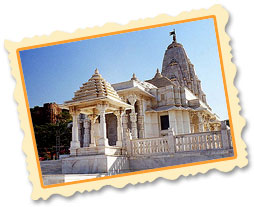
Situated just below Moti Dungri, the Birla Lakshmi Narayan Temple has a huge complex and is built in a contemporary style. The finest quality of white marble is used to build the temple and its beautiful stained glass widows depict scenes from Hindu mythology. The almost-transparent marble idol of Ganesh is a masterpiece while the idols of main deities of the temple, Goddess lakshmi and her consort Lord Vishnu, are carved out from one piece of marble. The temple houses several other Hindu deities along with great historical achievers, philosophers and religious giants such as Socrates, Zarathustra, Christ, Budhda, and Confucius.


The temple was built by Birla family, the famous industrialists of India, and has three domes, which are said to represent three different approaches to religion. Lord Vishnu, also popularly called as Narayan is one of the three main gods of Hindu Trinity while Goddess Lakshmi is said to be the bestower of wealth and good fortune. The beautiful exteriors of the temple are richly carved with beautiful sculptures based on various mythological themes while the interiors have a large marble panel depicting major mythological events. The idols of the main deities occupy the sanctum sanctorum of the temple. The temple itself is built on a platform and is surrounded by beautiful landscaped gardens.

Jaigarh Fort


Jaigarh Fort


The Jaigarh fort is the most spectacular of the three-hilltop forts that overlook Jaipur. In
Mughal times, the Jaipur region was a major weapon-producing centre for the Mughal and Rajput rulers, several of which are on display in the fort's
museum. It is one of the few military structures of medieval India preserved almost intact, containing palaces, a granary, a well-planned cannon foundry,
several temples, a tall tower and a giant mounted cannon-the Jai Ban (Jaivan) which is the largest cannon in the world. Jaigarh Fort is also known as the fort of victory. The display includes a collection of canons, many of which are exquisitely decorated and were used in the Mughal campaigns led by the Rajput King, Raja Man Singh.

Of the Jaipur's three forts, Jaigarh is perhaps the most motivating. It does not have those delicate structures or palaces like that of Amber but if you want a quick look at a hard-core fortress, this is it. Jaigarh means `Victory Fort' and was built between the 15th and the 18th century, and stands 15 km from Jaipur,amidst rock-strewn,thorn-scrub covered hills, its forbidding stone ramparts are visible from the Jaipur town. A steep road goes up to the main gate, the Dungar darwaza, from where the view is stupendous.

Nahargarh Fort


Nahargarh Fort is located on the sheer rugged ridge of Aravali Hills and it forms an impressive northern backdrop of Jaipur. It looks most classy when floodlit at night. The fort overlooks the city and presents a glittering view of the city lights. It was built in 1734 and extended in 1868. Nahargarh meaning abode of the tigers was built by Jai Singh to bolster the defence of Amber. The legend also have it that it was named Nahargarh after Nahar Singh a prince whose spirit would destroy the construction and not allow its progress further. So after a tantrik prayer to the spirit it agreed to leave on condition that the fort is named after him. The Madhavendra Bhawan, built by Sawai Ram Singh II has uniquely a cluster of 12 identical suits for queens and at the head is a suit for the king himself. The rooms are linked by corridors and retain some delicate frescos as well as toilets and kitchen hearths. It was used by members of the royal family for excursion in summers and is now even a favoured picnic spot. Durg Cafeteria just above the entrance sells meals and refreshments, while Padao Restaurant on the west sells drinks around sunset.

Amber


Amber (pronounced Amer) is situated about 11 kilometres from Jaipur and was the ancient citadel of the ruling Kachhawa clan of Amber, before the capital was shifted in the plains to present day Jaipur.

The Amber Fort set in picturesque and rugged hills is a fascinating blend of Hindu and Mughal architecture. Constructed by Raja Man Singh I in 1592 and completed by Sawai Jai Singh I the fort is made in red sand stone and white marble. The rugged forbidding exterior belies an inner paradise with a beautiful fusion of art and architecture. Amber is the classic and romantic fort- palace with a magnificent aura. The interior wall of the palace depicts expressive painting scenes with carvings, precious stones and mirror settings. In the foreground is the Maota Lake providing a breathtaking look. Built mainly for the warring enemies as a safe place, the heavily structured walls could defend the residents within the ramparts of the fort.

Sheeshmahal


The fort has 4 sections; each with the premises and one has to climb up through the imposing stairway or else the broad aisle, where one can ride on the elephant back for royal feel. The main gate Surajpol that leads to the Jaleb chowk, which is the main courtyard from where one can walk up the stairway, that leads to the palace. Jaleb Chowk was also the area where returning armies were welcome and they would display their war earnings to the population at large.

Before you enter the palace just towards the right is a sleep aisle and a narrow staircase reaching up to Kali Temple also called Shila Devi Temple famous for its mysterious history and the huge silver lions. It is a gorgeous temple featuring silver doors with raised relief. According to a legend, Maharaja Man Singh I had worshiped the Goddess for a victory over the rulers of Bengal. The Goddess appeared in the Maharaja's dream and ordered him to recover her statue lying under sea near Jessore (now in Bangladesh) and install it in a befitting Temple. True enough, after subjugating the enemies the Maharaja recovered the statute from the bed of the sea. The temple is called after Shila Devi, "shila" meaning stone slab. Like all temples this too has an image of Ganesha on the doorway, but carved from a single piece of coral.